Categoría: Uncategorized

  • hist4dem Aktion zum MLK Day

    Martin Luther King Jr. ist eine zentrale Figur der US-amerikanischen Geschichte und das Gesicht des Civil Rights Movement – im Kampf gegen Rassismus, Segregation, Armut und Krieg. Seit 1983 wird er am 3. Montag im Januar mit einem Feiertag geehrt, in diesem Jahr am 19.1. Gleichzeitig wird er von versch. Gruppen vereinnahmt. Wir werden diese Diskussionenn in Posts auf bsky und instagram vom 9.-20.1. näher einordnen.

    https://www.instagram.com/hist4dem/


  • Leser*innenbrief zu FAZ-Artikel «Wird Klio jetzt konservativ?»

    Am 29.08.2025 hatte Jannis Koltermann unter dem Titel „Wird Klio jetzt konservativ?“ einen Text in der FAZ veröffentlicht, über den in unserem Netzwerk rege diskutiert wurde. Den Leserbrief, den die hist4dem-Mitglieder Silke Silke Hensel und Katharina Kreuder-Sonnen verfasst haben, wird die FAZ nicht veröffentlichen. Daher stellen wir ihn hier zur Verfügung.


  • Widerstand in den USA (Organzation of American Historians)

    Academic Freedom as a Practice of Democracy

    At a panel during the Coalition for Action in Higher Education’s April 2025 national protest, urban and cultural studies scholar Davarian Baldwin made a rousing call for courage in the face of political and material repression in US colleges and universities: “We are the power that we have been waiting for.” Responding to this call, the 2026 volume of the AAUP’s Journal of Academic Freedom seeks to showcase work of students, educators, and activists—and of unions, scholarly associations, and other governance bodies—in fighting back against repression. We invite original scholarly articles grounded in a renewed notion of academic freedom as not only an abstract value or principle to be defended but also a living practice—as historian Joan Scott, among others, has put it—of research, teaching, and public engagement that articulates a democratic higher education and a democratic society.

    As a practice, academic freedom is embodied in the free, critical inquiry of students and scholars in their areas of expertise; in syllabi, curricula, and classrooms whose content is determined by experts rather than by administrators, boards of trustees, external special interest groups, or government agencies; and in the extramural speech and action of students and scholars, which are protected by the First Amendment and by AAUP principles. As recent court rulings have demonstrated, the practice of academic freedom unambiguously includes inquiry into, teaching about, and extramural speech and action pertaining to Palestine and other controversial topics. However, as experts on academic freedom have meticulously demonstrated, such practice is increasingly being delimited and circumscribed. National and international political discourses and federal investigations have pressured administrators—often all too willing to comply—to police protected speech and action on campuses, while the rise of neoliberal structures of governance at the expense of shared governance has created conditions of institutionalized disposability and precarity that further threaten the freedoms of academic workers. Under such conditions, the practice of academic freedom—resilient, defiant, and unwaveringly committed to the search for knowledge and the common good—itself becomes an instantiation of democracy over and against authoritarianism.

    To defend and fight for academic freedom is to defend and fight for democracy. With the explicit objective of contributing to this struggle, the new volume seeks submissions on initiatives that have been pursued, strategies that have been deployed, coalitions that have been built, and work that remains to be done in the fight for academic freedom.

    We will consider any eligible submission relevant to the journal’s core focus on academic freedom. Topics of special interest for the volume include but are not limited to

    • political education
    • public outreach
    • sanctuary campuses
    • mutual defense compacts and other forms of coalition-building
    • debt reveals
    • boycott, divestment, and sanctions campaigns
    • campus unionization
    • protests and other forms of mass mobilization
    • lawsuits
    • political lobbying

    The fight for academic freedom continues. But the efforts that have already been undertaken by educators and organizers suggest the formation of a new community both within and beyond the academy that is dedicated to the core freedoms on which any acceptable notion of the American university must be built—the freedom to think and to dream, to teach and to learn, to speak and to act, and to dissent in the face of authoritarianism and genocide. The proposed volume, which will be edited by Karim Mattar of the University of Colorado at Boulder, aims to help cultivate this community and these freedoms.


    Submissions of 2,000–5,000 words (including any notes and references) are due by March 9, 2026. The complete call for papers, our editorial policy, submission guidelines and instructions, and
    links to past volumes of the journal are available at https://www.aaup.org/CFP.
  • Guided Tour: «Trailblazers for Change»

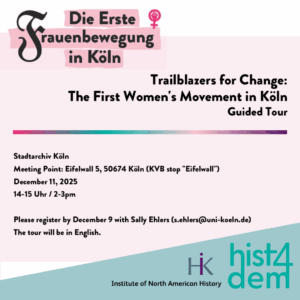
    Hist4Dem and the Institute of North American History at University of Cologne invite you to join a guided tour of the Stadtarchiv’s exhibition «Trailblazers for Change: The First Women’s Movement in Köln» on December 11, 2025, from 2:00 to 3:00 pm. The meeting point will be at Eifelwall 5, 50674 Köln (KVB stop “Eifelwall”). Please register by December 9 with Sally Ehlers at s.ehlers@uni-koeln.de. The tour will be in English.

  • Aktionen zum 9. November

    Hist4dem veranstaltet eine Reihe von Aktionen zum 9. November, dem Jahrestag mehrerer Schlüsselereignisse der deutschen Geschichte, u.a. eine online stattfindende Diskussionsveranstaltung mit Kirsten Heinsohn, Nadien Rossol, Michael Wildt und Ilko-Sascha Kowalczuk. Mehr Informationen dazu gibt es hier.

  • Die «Professor Watchlist» bedroht die Wissenschaftsfreiheit

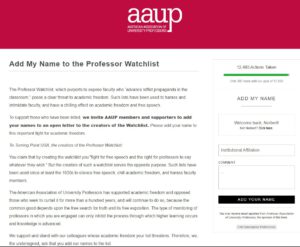
    Die Professor Watchlist ist eine Website, die von der konservativen Organisation «Turning Point USA» betrieben wird. Die Website listet akademisches Personal auf, das nach Ansicht von Turning Point «konservative Studenten diskriminiert, antiamerikanische Werte fördert und linke Propaganda im Klassenzimmer verbreitet». Sie wurde 2016 ins Leben gerufen und hatte bis Dezember desselben Jahres etwa 200 Professoren aufgelistet. Jetzt gibt es eine Initiative der American Association of University Professors, sich selbst «anzuzeigen» und so gegen die Liste zu protestieren. Bislang sind mehr als 12.000 Kolleg*innen dieser Aufforderung gefolgt.

  • Vortragsreihe zur kultursensitiven Psychiatrie an der Staatsbibliothek Berlin, 15.10.2925 bis 14.1.2026

    Vortragsreihe zur kultursensitiven Psychiatrie

    Deutschland ist ein Einwanderungsland, auch wenn Einige dies nicht wahrhaben wollen. Menschen aus allen Teilen der Erde leben in Deutschland, von denen viele eine Traumatisierung erfahren haben, weil sie unter beklagenswerten Umständen geflüchtet sind. Gewalterfahrungen vor und während der Flucht waren für sie allgegenwärtig. Unter diesen Geflüchteten befinden sich viele sehr junge Menschen und auch alleinstehende Kinder. Ihr Status in diesem Lande ist prekär. Ohne Sprachkenntnisse, ohne angemessene schulische Bildung und ohne therapeutische Betreuung sind sie sich selbst überlassen. Wir sind zurzeit nicht in der Lage, ihnen therapeutisch zu helfen, nicht nur, weil der politische Wille dazu fehlt, sondern auch, weil Therapeut:innen mit wenigen Ausnahmen nicht dafür ausgebildet sind, Menschen aus anderen Kulturen angemessen zu betreuen.https://blog.sbb.berlin/ethnopsychiatrie/

  • Historikertag 2025

    Auf dem 55. Deutschen Historikertag, der vom 16. bis 19. September in Bonn stattfindet, wird das hist4dem-Netzwerk mit einem eigenen Stand vertreten sein. Wir sind an allen Tagen im Arkadenhof anzutreffen. Außerdem werden wir uns am Mittwoch, 17.9., um 18:00 Uhr im Hörsaal 7 zum ersten Mal in Präsenz treffen. Wer Interesse hat, bei hist4dem mitzuwirken, ist herzlich willkommen. Weitere Informationen finden sich im Programm des Historikertags.