Autor: Norbert Finzsch

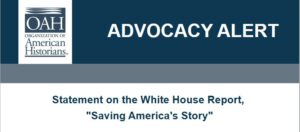
  • AHA Files Lawsuit to Defend the Presidential Records Act

    The AHA, in collaboration with American Oversight, filed a lawsuit last night challenging a recent memorandum from the Department of Justice declaring the Presidential Records Act unconstitutional, potentially blocking public access to hundreds of millions of records and presenting serious risk to transparency and recordkeeping throughout the executive branch, including the National Archives.

    This case is about the preservation of records that document our nation’s history, and whether the American people are able to access and learn from that history. We urgently need your support for our ongoing advocacy work, and ask that you consider making an immediate impact by donating to the AHA’s advocacy fund.

    Die AHA hat gestern Abend in Zusammenarbeit mit American Oversight Klage eingereicht, um ein kürzlich erlassenes Memorandum des Justizministeriums anzufechten, in dem das Gesetz über die Aufbewahrung von Präsidentschaftsunterlagen (Presidential Records Act) für verfassungswidrig erklärt wurde. Dies könnte den öffentlichen Zugang zu Hunderten Millionen von Unterlagen blockieren und stellt ein ernsthaftes Risiko für die Transparenz und die Archivierung in der gesamten Exekutive dar, einschließlich der National Archives.

    In diesem Fall geht es um die Aufbewahrung von Dokumenten, die die Geschichte unseres Landes dokumentieren, und darum, ob das amerikanische Volk Zugang zu dieser Geschichte hat und daraus lernen kann. Wir benötigen dringend Ihre Unterstützung für unsere laufende Lobbyarbeit und bitten Sie, durch eine Spende an den Lobbyfonds der AHA einen unmittelbaren Beitrag zu leisten.

    AHA

  • Defend History, April 16-19, 2026

    Aktion der Organization of American Historians
  • Initiative Demokratische Wissenschaft

    Zitat von der Webseite der «Initiative Demokratische Wissenschaft»:

    «Die Initiative Demokratische Wissenschaft wurde im Herbst 2025 gegründet und wird von einem Netzwerk zivilgesellschaftlicher und akademischer Organisationen getragen. Sie reagiert auf ein Klima zunehmender Angriffe auf Wissenschaft und Lehre und die Gefahr wissenschaftsfeindlicher Tendenzen in den Landes- und Bundesregierungen.
    Ziel der Initiative Demokratische Wissenschaft [WissDem] ist es, wissenschaftliche Einrichtungen, Netzwerke und Fachgesellschaften zu befähigen, Gefahren für die Wissenschaftsfreiheit und die Hochschulautonomie frühzeitig zu erkennen, und autoritären und antidemokratischen Angriffen auf Institutionen, Forschende und Lehrende zu begegnen.
    Wir unterstützen dabei, präventiv effektive Resilienzstrategien zu entwickeln und solidarische akademische Netzwerke aufzubauen.
    WissDem arbeitet mit Informationswebinaren, Handreichungen, Szenarienworkshops und strategischer Vernetzung. In Kooperation mit zivilgesellschaftlichen, universitären und außer-universitären Partner*innen werden Angebote zur Stärkung juristischer, kommunikativer und strategischer Kompetenzen gemacht, die insbesondere Hochschulleitungen, Wissenschaftler*innen, Verwaltungspersonal, Fachgesellschaften, Gleichstellungs- und Antidiskriminierungsbeauftragte adressieren.
    Kooperationspartner*innen:
    Frag den Staat (Open Knowledge Foundation e.V.), Gesellschaft für Freiheitsrechte (GFF), Allianz für Kritische und Solidarische Wissenschaft (KriSol), Netzwerk Nachhaltige
    Wissenschaft, Rat für Migration (RfM), Verfassungsblog, Verwaltung für Demokratie e.V.

    Lenkungsgruppe: Prof. Dr. Julia Eckert, Dr. Dörthe Engelcke, Dr. Anne Gräfe, Prof. Dr. Sabine Hark, Prof. Dr. Ralf Michaels, Zoe Claire Miller, Prof. Dr. Juliane Karakayali, Gisela Romain, Dr. llyas Saliba, Prof. Dr. Vassilis Tsianos, Prof. Dr. Margarita Tsomou
    Kontakt: Daphne Büllesbach (Leitung) daphne.buellesbach@wissdem.org und Lilian Mauthofer (Koordination) lilian.mauthofer@wissdem.org»

    Hist4Dem begrüßt die «Initiative Demokratische Wissenschaft» und weist auf die Gemeinsamkeiten unserer Programmatik hin. Zum Thema «Neutralitätsgebot» siehe unsere Position unter «Hot Topics» auf dieser Webseite.

  • Widerstand in den USA (Organzation of American Historians)

    Academic Freedom as a Practice of Democracy

    At a panel during the Coalition for Action in Higher Education’s April 2025 national protest, urban and cultural studies scholar Davarian Baldwin made a rousing call for courage in the face of political and material repression in US colleges and universities: “We are the power that we have been waiting for.” Responding to this call, the 2026 volume of the AAUP’s Journal of Academic Freedom seeks to showcase work of students, educators, and activists—and of unions, scholarly associations, and other governance bodies—in fighting back against repression. We invite original scholarly articles grounded in a renewed notion of academic freedom as not only an abstract value or principle to be defended but also a living practice—as historian Joan Scott, among others, has put it—of research, teaching, and public engagement that articulates a democratic higher education and a democratic society.

    As a practice, academic freedom is embodied in the free, critical inquiry of students and scholars in their areas of expertise; in syllabi, curricula, and classrooms whose content is determined by experts rather than by administrators, boards of trustees, external special interest groups, or government agencies; and in the extramural speech and action of students and scholars, which are protected by the First Amendment and by AAUP principles. As recent court rulings have demonstrated, the practice of academic freedom unambiguously includes inquiry into, teaching about, and extramural speech and action pertaining to Palestine and other controversial topics. However, as experts on academic freedom have meticulously demonstrated, such practice is increasingly being delimited and circumscribed. National and international political discourses and federal investigations have pressured administrators—often all too willing to comply—to police protected speech and action on campuses, while the rise of neoliberal structures of governance at the expense of shared governance has created conditions of institutionalized disposability and precarity that further threaten the freedoms of academic workers. Under such conditions, the practice of academic freedom—resilient, defiant, and unwaveringly committed to the search for knowledge and the common good—itself becomes an instantiation of democracy over and against authoritarianism.

    To defend and fight for academic freedom is to defend and fight for democracy. With the explicit objective of contributing to this struggle, the new volume seeks submissions on initiatives that have been pursued, strategies that have been deployed, coalitions that have been built, and work that remains to be done in the fight for academic freedom.

    We will consider any eligible submission relevant to the journal’s core focus on academic freedom. Topics of special interest for the volume include but are not limited to

    • political education
    • public outreach
    • sanctuary campuses
    • mutual defense compacts and other forms of coalition-building
    • debt reveals
    • boycott, divestment, and sanctions campaigns
    • campus unionization
    • protests and other forms of mass mobilization
    • lawsuits
    • political lobbying

    The fight for academic freedom continues. But the efforts that have already been undertaken by educators and organizers suggest the formation of a new community both within and beyond the academy that is dedicated to the core freedoms on which any acceptable notion of the American university must be built—the freedom to think and to dream, to teach and to learn, to speak and to act, and to dissent in the face of authoritarianism and genocide. The proposed volume, which will be edited by Karim Mattar of the University of Colorado at Boulder, aims to help cultivate this community and these freedoms.


    Submissions of 2,000–5,000 words (including any notes and references) are due by March 9, 2026. The complete call for papers, our editorial policy, submission guidelines and instructions, and
    links to past volumes of the journal are available at https://www.aaup.org/CFP.

  • Akademie der Diözese Rottenburg-Stuttgart: Für eine demokratische Gesellschaft

    Historiker:innen gegen Angriffe auf die Freiheit der Wissenschaft


    https://www.akademie-rs.de//ueber-uns/newsletter-und-social-media/akademie-newsletter-nov-2025

  • Die «Professor Watchlist» bedroht die Wissenschaftsfreiheit

    Die Professor Watchlist ist eine Website, die von der konservativen Organisation «Turning Point USA» betrieben wird. Die Website listet akademisches Personal auf, das nach Ansicht von Turning Point «konservative Studenten diskriminiert, antiamerikanische Werte fördert und linke Propaganda im Klassenzimmer verbreitet». Sie wurde 2016 ins Leben gerufen und hatte bis Dezember desselben Jahres etwa 200 Professoren aufgelistet. Jetzt gibt es eine Initiative der American Association of University Professors, sich selbst «anzuzeigen» und so gegen die Liste zu protestieren. Bislang sind mehr als 12.000 Kolleg*innen dieser Aufforderung gefolgt.